中文简体
中文简体
Ana sayfa / Haberler / Sektör Haberleri / Amplifier Class Guide: A, AB, D, and H for Powered Speaker Module Design
Specify a 500 W Class AB stage for a sealed powered speaker and you take on roughly 400 W of waste heat inside a cabinet the size of a carry-on bag. Specify a Class D module for the same 500 W and the heat load drops to around 55 W. The acoustic output on the spec sheet can look almost identical; the thermal design, transformer rating, cabinet volume and shipping weight will not.
The short answer: for new powered speakers, line arrays and portable systems, Class D is the default. Class H still earns its place in high-output subwoofers and installed sound systems where a linear output stage and a simple transformer supply are preferred. Class AB remains widespread in legacy designs, instrument amplifiers and powered mixers. The sections below explain what the class letter actually controls, where each class wins, and which checks keep a module from failing in production.
What an Amplifier Class Actually Describes
An amplifier class describes the bias condition of the output stage, and specifically how much of the input signal cycle each output device conducts. That single parameter sets the theoretical efficiency ceiling, the distortion mechanism and the heat the stage has to shed.
- Class A — the device conducts through the full 360 degrees of the cycle. Excellent linearity, lowest efficiency of any linear class.
- Class B — two devices each conduct 180 degrees and hand over at the zero crossing. Efficient in theory, but the handover creates crossover distortion.
- Class AB — each device conducts somewhere between 180 and 360 degrees, pushing crossover distortion below audibility at the cost of some efficiency.
- Class D — the output devices switch on and off at high frequency instead of tracking the waveform, so efficiency comes from switching rather than from linear amplification.
- Class G and H — linear stages whose supply rail steps or tracks the signal, so the output devices only ever see the voltage they need.
The class letter is not a quality rating. A well-implemented switching stage can measure better than a mediocre linear one, and a poorly filtered Class D module can produce artifacts a Class AB design would never show. What the letter predicts reliably is wasted power, heatsink and supply size, and the cost of building and shipping the finished product.
Typical full-power efficiency by amplifier class
Practical ranges for audio output stages. Class H efficiency depends on how often its rails step or track.
Amplifier Class Comparison at a Glance
The table below summarises the classes you are most likely to see in a module catalogue, together with the design decision each one forces.
| Class | Conduction or mode | Typical efficiency | Where it appears | Design consequence |
|---|---|---|---|---|
| A | 360 degrees | 25–30% | Studio monitors, hi-fi | Large heatsink, high idle current |
| B | 180 degrees per device | 50–70% | Rare in audio, common in textbooks | Crossover distortion at handover |
| AB | 180–360 degrees | 50–65% | PA amps, instrument amps, powered mixers | Simple supply, heatsink sized for continuous output |
| C | Under 180 degrees | 60–80% | RF transmitters, not audio | Distortion too high for audio use |
| D | Switching on and off | 80–92% | Powered speakers, line arrays, subwoofers | EMI layout, output filter, dead-time control |
| G | Stepped supply rails | 60–75% | High-power hi-fi, installed systems | Rail switching adds cost and complexity |
| H | Continuously tracking rails | 65–80% | Subwoofers, large installed sound | Rail modulator plus linear transformer supply |
Classes E and F belong to radio frequency design and rarely appear in audio hardware, which is why they are left out of the table above.
Why Efficiency Turns Into Cabinet Size, Weight and Cost
Efficiency percentages become useful once you convert them into watts. For a 500 W output stage, a Class A design at roughly 30% efficiency draws about 1667 W from the mains, a Class AB stage at 55% draws about 909 W, a Class H stage at 75% draws about 667 W, and a Class D module at 90% draws about 556 W.
Every one of those watts has to be supplied by the transformer and removed from the enclosure. That drives heatsink mass, fan noise, ventilation openings and the weight of every unit you ship. Temperature also affects reliability: a widely used rule of thumb in power electronics is that every 10 °C drop in operating temperature roughly doubles the life of an electrolytic capacitor.
Mains power drawn per 500 W of audio output
1667 WClass A
909 WClass AB
667 WClass H
556 WClass D
Illustrative calculation using typical efficiencies of 30%, 55%, 75% and 90% respectively.
Class D Amplifier Modules: The Default for New Powered Speakers
Class D output devices switch rather than amplify linearly, so losses are dominated by conduction and switching instead of by standing bias current. Practical modules reach 80–92% efficiency, which is why nearly every new portable speaker, line array element and compact subwoofer is built around a switching module.
The trade-offs move into the supply and the board layout. A resonant LLC supply with power factor correction keeps the bus stable across a wide mains range and holds switching noise in a predictable band, which makes EMI filtering easier. Output filter inductors, dead time and gate-drive routing decide whether the module passes emissions limits and stays stable into a 4 ohm load.
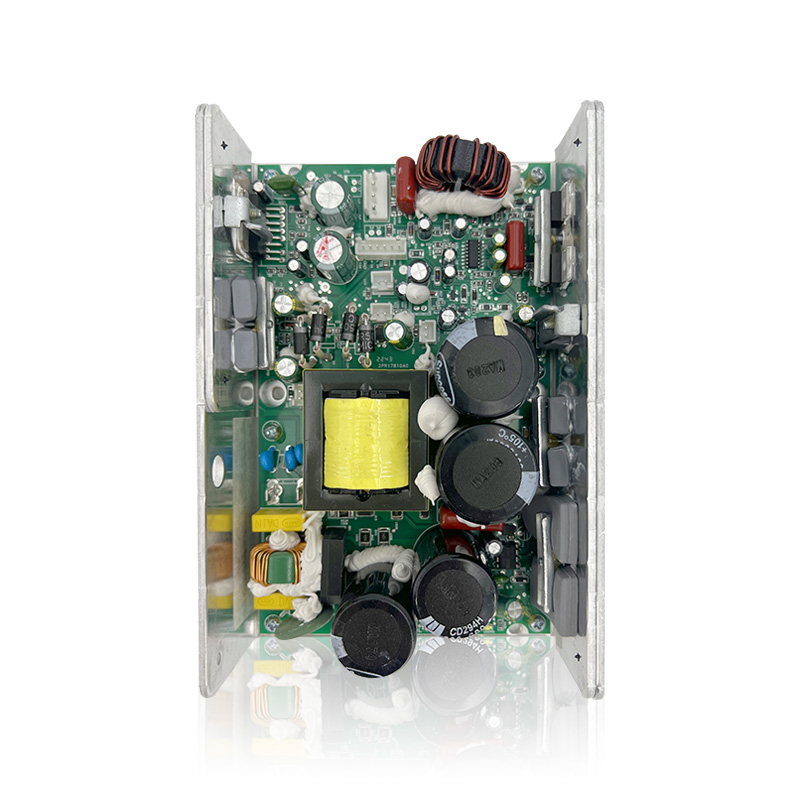
A representative example is the eon520-2092 module, rated LP500W/HP200W with a PFC and LLC resonant front end and wide-voltage input.
Class H Modules: Still the Right Answer for High-Output Subwoofers
Class H is a linear class with supply rails that step or track the audio signal. Because the output devices never drop the full bus voltage across themselves at low output levels, efficiency lands in the 65–80% band — well below Class D, but with far less high-frequency switching content. That is one reason Class H designs remain common in large subwoofer amplifiers and installed sound systems.
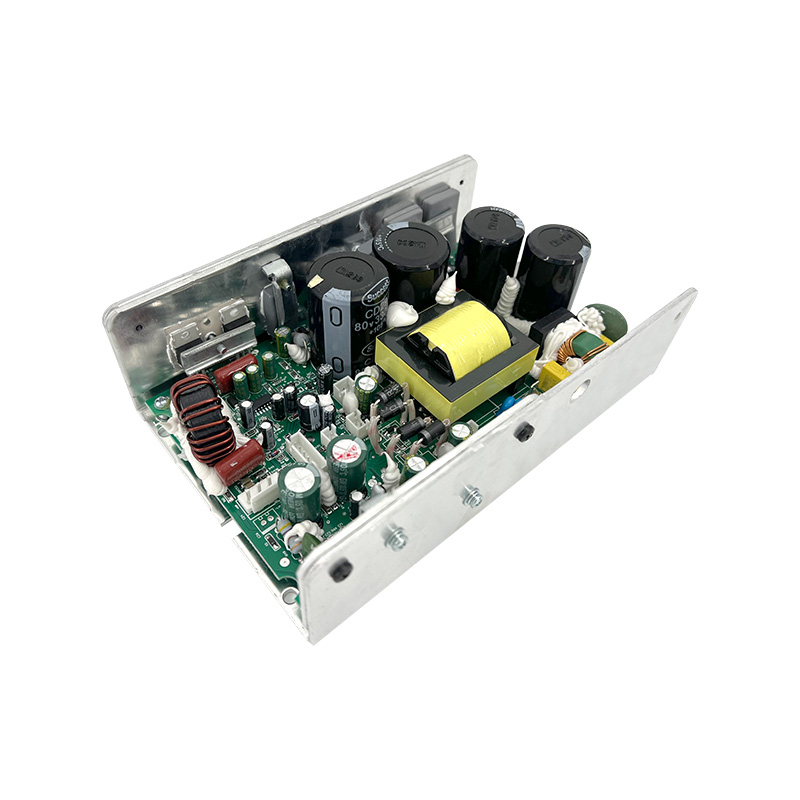
Modules in this category typically use a linear transformer supply and rely on substantial heatsinking. The amp400h-7294, for instance, is rated LP400W/HP100W and uses a U-shaped aluminium radiator to handle continuous output, while the amp600s-fp is aimed specifically at subwoofer duty.
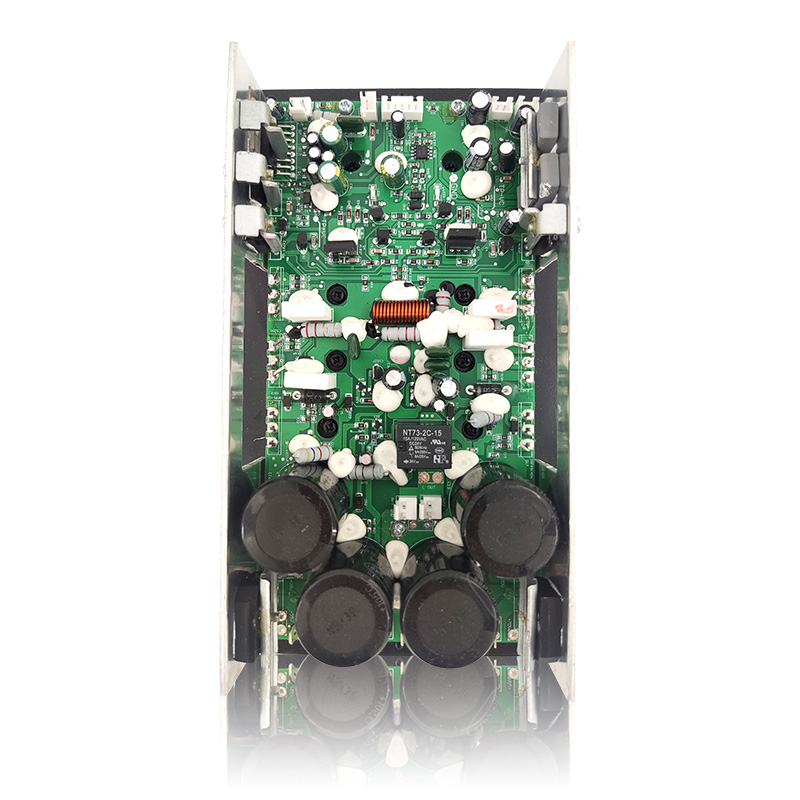 AMP400H+7294: LP 400W+HP 100W Poweful Output with U-shaped Aluminum Radiator Class H Power● Linear transformer power: 500W ● Mid and low-frequency power amplifier: Class H 400W-4Ohm ● High-frequency power amplifier: Class AB 100W-8 Ohm ● U-shaped aluminum r...View Product →
Matching the Amplifier Class to the Rest of the Module Set
The amplifier class only makes sense in the context of the whole module set. A powered speaker usually stacks four functions: input and volume control, a DSP core, a crossover or EQ stage, and the power stage that drives the transducers.
Typical four-layer module stack in an active speaker
Functional layers of an active speaker module set, from input to loudspeaker output.
Matching matters at the boundaries. The DSP module sets the limiter threshold and the crossover point, so it needs to know the real output voltage swing of the power stage, and the power stage needs a load it can drive safely at the driver's minimum impedance. Modules built on a single DSP platform keep the control interface and preset structure consistent across models — the dsp1903, for example, stores four customised preset EQ modes for a 2.1-channel line array system. A supplier that designs both halves in house, such as Ningbo Huage Electronics, can adjust those boundaries together rather than negotiating them between two vendors.
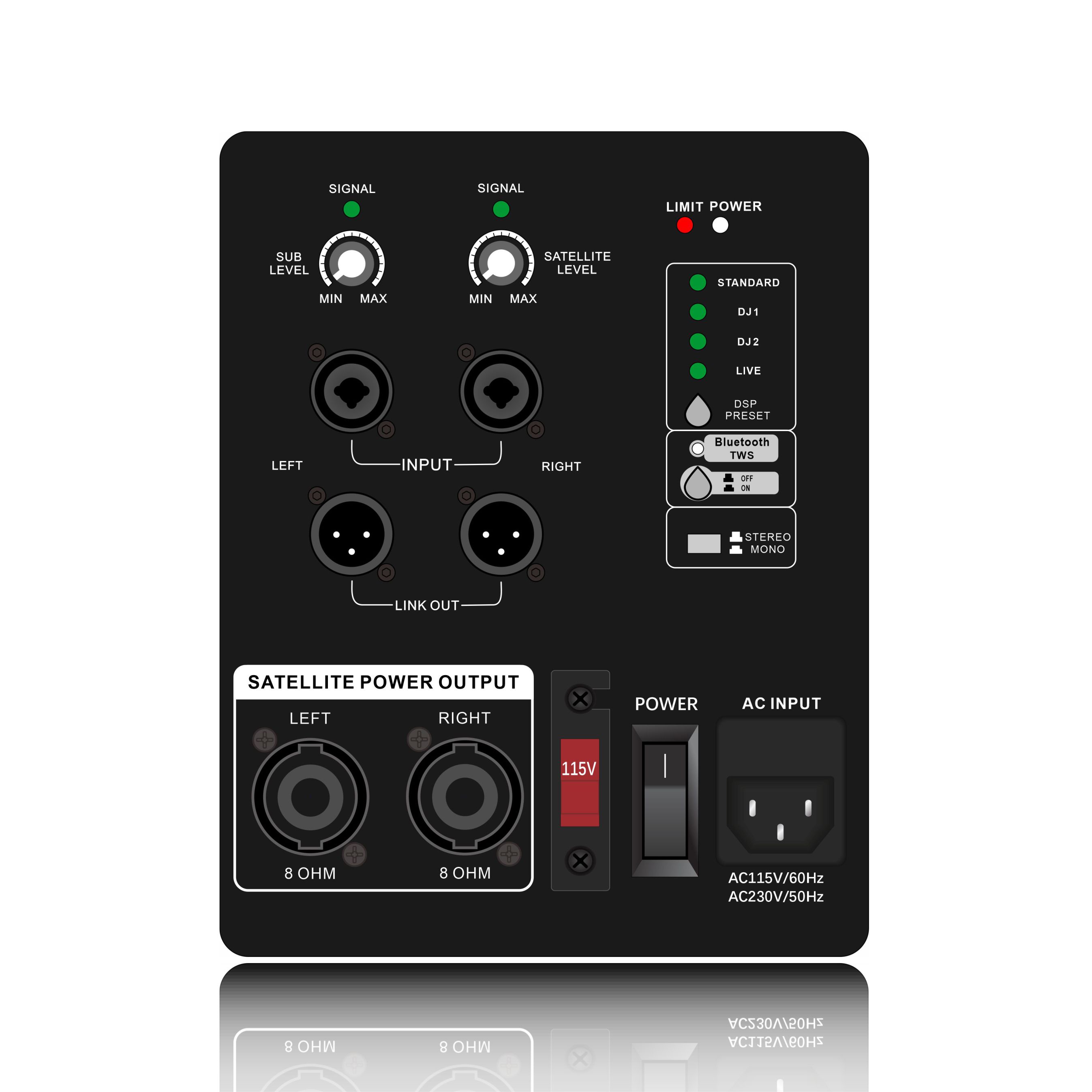 DSP1903: 4 Customized Preset EQ Modes 2.1CH Linear Array Speaker ADAU1701 Based DSP Functi● Designed based on ADAU1701 sound audio system. Use sigma studio DSP software to configure signal processing parameters. ● Selectable four customized preset modes whi...View Product →
Practical Checks Before You Commit to a Class
Whichever class you shortlist, these five checks catch most problems before tooling starts.
- Work from minimum impedance, not nominal. A driver rated at 8 ohm nominal can dip well below that at some frequencies, and amplifier module and speaker impedance matching has to be verified against that minimum.
- Convert efficiency into heat at the worst case, not the average. Programme material has a crest factor, but a limiter will hold long-term power close to the rating during a show.
- Check the supply against the mains. Wide-voltage switching modules tolerate brownouts and generator supplies better than fixed linear rails.
- Confirm the protection scheme in writing. Over-current, over-temperature and DC-offset behaviour should be specified, not assumed.
- Verify the thermal path. Heatsink mounting torque, thermal pad specification and airflow all influence field failure rates.
Class AB, D and H compared across five design criteria
Class DClass HClass AB
Qualitative comparison on a five-point scale for typical module-level designs.
Frequently Asked Questions About Amplifier Classes
Q1. What are the main amplifier classes used in audio?
Class A, Class AB, Class D and Class H cover almost all audio equipment. Class A conducts through the full signal cycle, Class AB through more than half of it, Class D switches the output devices at high frequency, and Class H is a linear stage whose supply rails track the signal.
Q2. Which amplifier class is best for a powered speaker or subwoofer?
For powered speakers, line arrays and portable systems, Class D is usually the starting point because of its efficiency and small thermal footprint. For very high output subwoofers and installed systems, Class H often gives a better balance of cost, linear behaviour and simple transformer supply design.
Q3. Is a Class D power amplifier module as good as Class AB?
When it is engineered properly, yes. Class D modules now drive line arrays and subwoofers routinely. The deciding factors are the output filter, gate-drive layout, EMI performance and the protection design rather than the class letter itself.
Q4. How efficient is a Class D amplifier compared with Class A and Class AB?
Practical Class D audio modules run at roughly 80–92% at full power, against about 50–65% for Class AB and 25–30% for Class A. A 500 W Class D module therefore dissipates in the region of 45–125 W of heat instead of the 400 W or more a Class AB stage would produce.
Q5. What does Class H mean in a power amplifier module?
Class H is a linear output stage whose supply rail steps up or tracks the audio signal, so the output devices only see the voltage they need. Efficiency typically lands between 65% and 80%, higher than Class AB but below Class D, with less high-frequency switching content than a switching module.
Q6. Does amplifier class affect sound quality, or only efficiency and heat?
Class changes the distortion mechanism and the thermal behaviour rather than the sound quality by itself. A clean Class D module and a clean Class AB module can both be transparent; audible differences usually come from implementation, filtering, protection behaviour and the DSP settings in front of the power stage.